Kingston Office Removals Case Study: Small Business Move Success
Moving a small office can feel deceptively simple right up until the boxes start stacking, the Wi-Fi goes down, and someone asks where the printer cable is. This Kingston office removals case study small business move success article is here to show what a well-planned move looks like in the real world: calmer, faster, and far less disruptive than most owners expect. If you are weighing up a move in Kingston, trying to protect trading hours, or just want a clearer way to organise people, equipment, and paperwork, you are in the right place.
Below, you will find a practical breakdown of why office removals matter, how a move tends to work, what success looks like for a small business, and where the common traps are hiding. We will also look at storage, packing, compliance, and the kind of decisions that save time on moving day and a lot of stress the week after. Let's face it, the week after is usually where the real story begins.
Why Kingston office removals case study small business move success Matters
A small business office move is not just a logistics job. It affects revenue, team morale, customer response times, data security, and whether your first morning in the new space feels organised or slightly chaotic. In Kingston, where many businesses operate on tight schedules and shared access routes, the margin for error can be smaller than people think.
A strong move matters because it protects continuity. That means fewer lost working hours, fewer damaged items, less confusion about who is doing what, and a smoother reopening. For service-based firms, even a half-day delay can throw off appointments, deliveries, or client calls. For businesses with documents, stock, or specialist equipment, one poor packing decision can ripple for weeks.
There is also a reputational angle. Customers rarely care that you had a tough moving day. They care that you answered on time, found their file, or had the stock ready. A successful office move supports all of that quietly in the background. You do not notice it much when it goes well, which is kind of the point.
In our experience, the businesses that do best are not always the biggest. They are the ones that prepare early, cut unnecessary clutter, and make sensible use of services like office removals and office storage where temporary space helps bridge the gap. That simple combination can turn a stressful relocation into a controlled transition.
How Kingston office removals case study small business move success Works
At its core, a successful small business office move follows a predictable pattern: assess, plan, pack, move, settle, review. The details change depending on your office size, building access, and how much equipment you have, but the structure is fairly steady.
The first stage is a practical survey of what is moving. That includes desks, chairs, IT hardware, printers, filing, archived documents, small stock items, and anything else living in cupboards or under tables. It is surprising how often the hidden stuff takes longer than the obvious stuff. There is always one drawer full of leads, sticky labels, and a mystery charger from 2019.
Next comes timing. A move is easier when it is scheduled around trading patterns. For example, a quiet Friday afternoon into a weekend may be more manageable than trying to shift the entire operation mid-week. Some businesses also split the move into phases, using removals and storage so non-essential items can be moved out early and returned once the new premises are ready.
Packing then becomes a method, not a scramble. Good packing labels, floor plans, colour coding, and clear ownership for each department or function reduce confusion later. If you are moving important records, using document storage or secure holding for a short period can reduce the risk of misfiling, damage, or accidental disposal.
On move day, the team should know the sequence: what goes first, what stays last, what is fragile, what needs immediate reconnecting, and who has the keys. If the plan is sound, the new office can be made functional surprisingly quickly. Not always perfectly neat on minute one, but usable. That matters more.
Key Benefits and Practical Advantages
A well-managed office move brings more than transport. It can give a small business a reset. New layout, better storage, less clutter, better flow. The change itself can improve how the team works.
- Reduced downtime: careful sequencing means the business can resume sooner.
- Better asset protection: organised packing lowers the chance of damage.
- Stronger data and document control: fewer lost files, fewer awkward surprises.
- Less staff disruption: people know what to expect and where to go.
- Improved space planning: the new office can be arranged around real needs rather than old habits.
- Cleaner move structure: storage, packing, and transport are easier to coordinate when handled together.
There is also a less obvious benefit: decision clarity. A move forces business owners to decide what is actually essential. Do you really need three old monitors? Are those archive boxes current records, or just office habit in cardboard form? Once you start asking those questions, the whole operation becomes lighter.
For some businesses, the right support package includes packing services and business storage, especially when the move has to happen in stages. For others, lighter jobs can be handled with man and van support or smaller-scale small removals if the office footprint is modest.
Who This Is For and When It Makes Sense
This topic is most relevant to small and medium-sized businesses in Kingston that need to relocate without stopping the lights from staying on. Think consultants, accountants, agencies, clinics, design studios, local service firms, e-commerce operations, and any team with a mix of office furniture, paperwork, and tech.
It also makes sense for businesses that are:
- moving from a home office into a first proper workspace
- downsizing after a contract change or team restructure
- expanding into a larger unit with more storage or meeting space
- relocating because lease timing, rent, or layout no longer fits
- needing temporary storage while refurbishment or handover work happens
If your team is mostly remote, the move might be smaller but still important. A few critical items often need special handling: files, servers, branded materials, POS equipment, or backup stock. That is where secure storage can be useful, especially if access needs to be controlled during the transition.
Small businesses with mixed personal and business items can also use this moment to separate the two properly. It sounds obvious, but in practice, offices often contain a little bit of everything. A box of product samples here, household bits there, a spare office lamp borrowed from home. The move exposes all of it.
Step-by-Step Guidance
Here is a practical move sequence that keeps things manageable. It is not glamorous, but it works.
- Start with a room-by-room inventory. Record furniture, equipment, documents, and anything fragile or high-value.
- Decide what should move, store, recycle, or be replaced. Do this early enough to avoid last-minute clutter.
- Assign responsibility. Someone should own IT, someone should own documents, and someone should own the final checks.
- Label everything clearly. Use destination labels, content labels, and priority labels. Yes, all three can help.
- Protect sensitive items. Confidential files and devices need careful handling and sensible access control.
- Book the right help. Match the service to the move size, building access, and time available.
- Prepare the new office first. Check access, lift use, parking, unloading points, and where key items will land.
- Move in phases if needed. This can keep trading interruption lower than an all-at-once move.
- Test essentials immediately. Internet, phones, power, and one or two key workstations should be ready first.
- Review after the move. Capture what worked, what slowed things down, and what should change next time.
If documents are involved, it is wise to build a short indexing process before the move. A simple folder map or box list is often enough. No need for fancy software if the team is small. A neat spreadsheet and disciplined labelling can do more than people expect.
Expert Tips for Better Results
The best advice is often very unexciting. That is usually a good sign.
1. Move less than you think you need. Office moves get easier when you reduce volume first. Old leaflets, obsolete stationery, broken peripherals, duplicate chairs, unused archive material - these can all be reviewed before the van arrives.
2. Keep a first-day essentials box. Include chargers, scissors, tape, basic stationery, keys, a kettle if you are feeling kind, and anything needed to reopen the office before lunch. People always forget the boring bits. Then they need them at 9:15.
3. Protect the work rhythm, not just the furniture. The real goal is not just moving desks. It is preserving the business rhythm. Prioritise the things that let your team work.
4. Use storage as a buffer, not a dumping ground. Temporary space can be incredibly useful if it is planned. If it is just a place to shove uncertainty, the problem comes back later.
5. Walk the route beforehand. Lifts, stairs, loading points, and tight corners matter more than people assume. A five-minute check can save a lot of heavy lifting and a little grumbling too.
One more thing: if your business handles confidential materials, make sure the packing process is tidy and limited to the right staff. Not dramatic, just sensible. Good moves are usually built on boring discipline.
Common Mistakes to Avoid
Most move problems are not random. They are predictable. That is actually helpful, because it means they can be prevented.
- Leaving planning too late: rushed moves are almost always more expensive in time and stress.
- Underestimating access issues: parking, lift size, loading restrictions, and narrow corridors can slow everything down.
- Packing without a system: mixed boxes become a mess when you unpack.
- Moving everything at once: sometimes phased relocation is simply the smarter option.
- Ignoring IT and comms: if internet and phones are not ready, the office is not really open.
- Forgetting documents: paper records still matter, and they go missing more easily than people like to admit.
- Not telling clients early enough: even a modest delay can cause avoidable frustration.
A quieter mistake is failing to think about the week after. The office may be technically moved, but if boxes are still sealed, labels are inconsistent, or storage is a mess, the team will feel it. That first post-move week sets the tone.
Tools, Resources and Recommendations
You do not need an elaborate toolkit for a small office move. You need the right basics, used properly. In most cases, the practical stack looks like this:
- strong boxes in a few different sizes
- packing tape and a simple dispenser
- labels or marker pens that actually show up on cardboard
- stretch wrap for awkward items
- folder lists for document tracking
- a floor plan for the new premises
- an internal contact list for move day
If you want a simpler route, the most useful service pages to review are office removals, office storage, and packing services. For businesses with smaller item counts, man and van can be a sensible fit. If you are trying to preserve work in progress between buildings, removals and storage is often a better conversation than pure transport.
It can also help to review the provider's trust pages before booking, especially for payment, safety, and service expectations. The pages for payment and security, insurance and safety, and terms and conditions are worth checking so you know what is covered and how the service is structured.
Law, Compliance, Standards, or Best Practice
Office moves often touch on data handling, building safety, and business continuity. While each business has its own obligations, there are some broadly sensible UK best practices worth keeping in mind.
First, confidential records should be packed and transported with care. If files contain personal data or client information, access should be limited during the move, and boxes should be clearly tracked. That is simple good practice, whether you are moving paper files or devices with stored information.
Second, make sure the moving process follows reasonable health and safety precautions. Lifting heavy items, using stairs, navigating tight spaces, and dealing with awkward furniture all need common sense and clear coordination. If a job involves heavier loads, damaged packaging, or awkward access, it is better to slow down than to guess. No one wants an avoidable injury on move day. No one.
Third, if your business has storage between premises, use a provider with a clear approach to security, access, and item handling. A reliable business storage arrangement is not just about space; it is about controlled process.
Finally, if you are disposing of old equipment or surplus materials, think about recycling responsibly. Many moves create a surprising amount of waste, and a tidy clearance plan is usually better for everyone. A practical sustainability mindset can sit neatly alongside a commercial one.
For a fuller sense of the company's standards and policies, it can be useful to review the health and safety policy, recycling and sustainability, and about us pages. Those pages help set expectations around how work is handled, and that reassurance matters when you are trusting someone with your office contents.
Options, Methods, or Comparison Table
There is no single best way to move a small business office. The right method depends on time, volume, access, and how much risk you want to carry yourself.
| Approach | Best for | Strengths | Trade-offs |
|---|---|---|---|
| Full office removals | Businesses relocating most or all furniture and equipment | Structured, efficient, less internal lifting | Needs careful planning and coordination |
| Removals and storage | Moves with timing gaps or phased handovers | Flexible, useful for refurbishment or lease overlap | Requires clear labelling and item tracking |
| Man and van | Smaller offices or lighter loads | Simple, flexible, often quick to organise | Less suitable for larger furniture volumes |
| Office storage only | Businesses needing temporary holding space | Helps protect items during delays or setup | Not a complete relocation solution on its own |
| Packing services added to a move | Teams short on time or admin capacity | Reduces workload and packing errors | Needs good labelling instructions from the business |
For many Kingston businesses, the sweet spot is a hybrid. A little storage, some packing support, and a move plan that matches the actual size of the office. Not too much, not too little. Just enough to keep things moving without chaos.
Case Study or Real-World Example
Here is a realistic example based on the kinds of small office moves people in Kingston often face. A five-person professional services firm needed to move from a compact office into a nearby workspace after a lease change. They had desks, chairs, boxed files, desktop computers, and a modest amount of branded material. Not a huge operation, but definitely enough to become messy if handled casually.
The business did three things well. First, it sorted old stock and paperwork before the move, so fewer boxes travelled than originally expected. Second, it moved non-essential items into temporary holding space using short term storage, which reduced pressure on moving day. Third, it labelled every workstation and file box by destination so that setup in the new office was straightforward.
What made the move successful was not speed alone. It was sequencing. The team had the right items ready first, while less urgent material followed later. That meant the phones could be answered, staff could work, and the office did not feel like an unpacked warehouse. A few boxes stayed on the side for a day or two. Fine. That happens. But the core operation restarted quickly, and that was the real win.
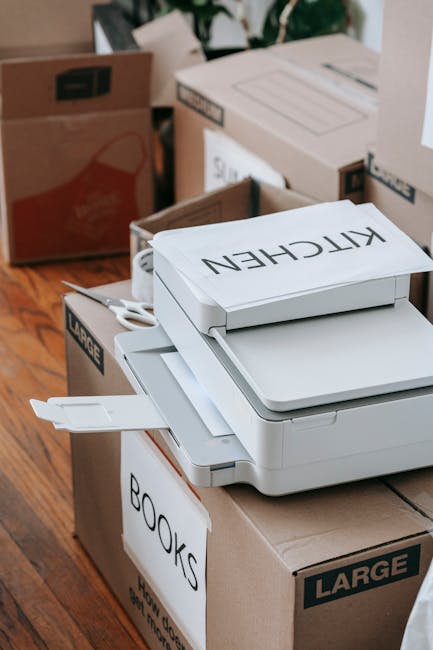
There was one slightly awkward moment involving a printer that was heavier than everybody remembered. Of course there was. But the route had been checked in advance, so the issue was solved with very little fuss. Human planning beats heroic lifting every time.
Practical Checklist
Use this checklist to keep the move grounded and manageable:
- confirm move date, access times, and parking/loading arrangements
- identify the items that must be available on day one
- create a full inventory of office furniture, IT, and documents
- remove or recycle anything that no longer adds value
- label boxes by room, function, and priority
- back up digital files and protect key devices
- prepare a first-day essentials box
- decide whether any items need secure storage
- brief staff on what they need to pack and when
- check the new office is ready for unloading and setup
- test power, internet, and phones early
- review what worked once the move is complete
One short note here: if a move feels too big to manage in one pass, split it. Small businesses often do better with a phased approach than with a dramatic one-day reset. It is less exciting, maybe, but far safer.
Get a free quote today and see how much you can save.
Conclusion
A Kingston office move does not need to become a drawn-out headache. With early planning, clear labelling, sensible use of storage, and the right level of removal support, a small business can move into a new office with far less disruption than most owners fear. The biggest difference usually comes down to organisation, not force.
If you are planning your own move, focus on the essentials first: what has to work immediately, what can wait, and what needs to be kept secure in between. That mindset alone can save time, reduce stress, and make the whole thing feel much more under control. And honestly, that calm feeling on the first morning in the new space is worth a lot.
Small move, big relief. That is the quiet success most businesses are really after.
Frequently Asked Questions
What makes a Kingston office removals case study useful for small businesses?
It shows how planning, storage, packing, and timing come together in a real relocation. Small businesses can then see what matters most and avoid common mistakes.
How far in advance should a small business plan an office move?
Earlier is better. Even a modest office move benefits from a clear timeline, inventory, and a booking plan so access, packing, and setup do not become rushed.
Should I use office storage during a move?
If there is a gap between leaving one office and entering the next, or if you want to move in stages, office storage can make the process much easier.
Is packing services worth it for a small office?
Often, yes. If your team is busy, your packing standards need to be consistent, or you are handling fragile items, packing services can save a lot of time and reduce errors.
What is the difference between removals and storage and a straight office move?
A straight move takes items from one site to another. Removals and storage gives you a buffer when timing, access, or setup does not line up neatly.
How do I keep confidential files safe during an office move?
Use controlled packing, limit access to the boxes, track document containers carefully, and move only what is necessary. For sensitive material, secure storage is often the safer option.
Can man and van work for an office relocation?
Yes, if the office is small and the load is manageable. It is a good fit for lighter moves, but larger furniture or more complex setups may need a fuller removals service.
What should I put in a first-day essentials box?
Include chargers, stationery, tape, scissors, keys, labels, and anything needed to get the team working straight away. A kettle is optional, but morale matters too.
How can I reduce downtime during a move?
Move in phases, pack by function, prepare the new office in advance, and make sure IT and communication essentials are prioritised first.
What are the most common mistakes during office removals?
Late planning, poor labelling, ignoring access constraints, and forgetting about documents or IT. Those are the usual trouble spots.
Do I need to think about health and safety for a small office move?
Yes. Even small moves involve lifting, carrying, and awkward access points. Simple precautions make a big difference and help avoid injuries.
Where should I start if I am comparing move options?
Start with your item volume, access conditions, timing, and whether you need temporary storage. Then compare office removals, storage, packing, and smaller vehicle options based on that reality, not guesswork.
Can a small move still benefit from business storage?
Absolutely. Business storage is useful when you want to clear space, stage the move, or keep non-essential items out of the way until the new office is ready.